Political violence and our democracy: Where are we headed?
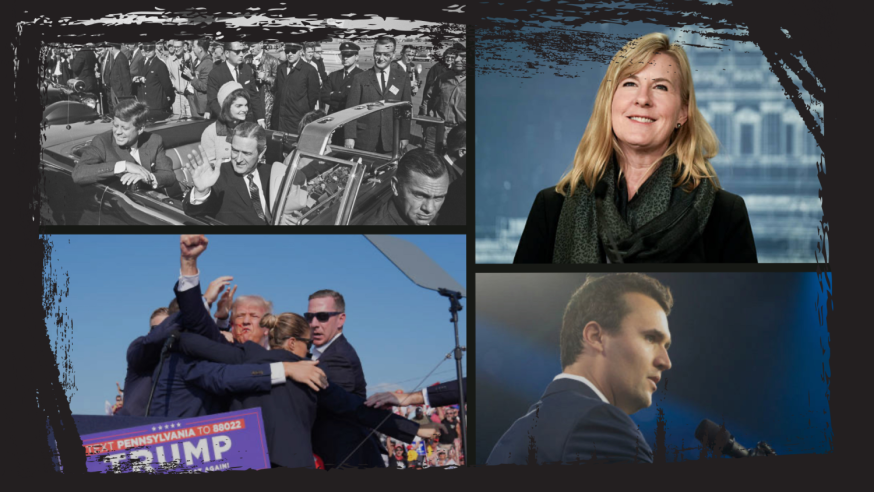
In 2012, Charlie Kirk graduated from Wheeling High School, just 13 miles from Conant. He then studied at Harper College, but, according to The Guardian, dropped out in order to pursue political activism. Even then, he showed interest in conservative politics and had a media presence, appearing on Fox Business at 17 years old. On September 10, Kirk was shot and killed at Utah Valley University while debating students on political issues. Suspect Tyler Robinson is currently in custody, with the death penalty possible if convicted.
While authorities place Robinson as the culprit, it is hard to ignore the influence of something bigger than just one person–something used mindlessly by millions, and something exploited by Kirk himself: social media.
Political figures, like Kirk, make social media content that often creates online echo chambers. A Democrat might read “Why Do Democrat Women Want To Die Alone?” and roll their eyes, and a Republican would do the same to “The Republican Plan To End Elections.” But as long as the Republican clicks on the first, and the Democrat clicks on the second, an economy exists. Clicks are views, views are money, and money—well, money is money, the ultimate goal. While the creator certainly wins, America does not.
Content like this exaggerates the “other side,” furthering an already strong political divide. Repeat this 100 times, make it all that a person sees, and Kirk’s murder becomes a lot more understandable. He wasn’t like John F. Kennedy or Martin Luther King, Jr., two political figures who were also assassinated. They were powerful leaders and symbols in their era, naturally putting them at risk. Their deaths could sensibly happen at any place or any time; Charlie Kirk’s could only happen in 2025.
On social media, responses have been varied. Users on TikTok showed little mercy for the conservative. Edits were made of Beyoncé and Taylor Swift, two women he had criticized in the past, taking on the role of the gunman and firing at him. More serious users compared Kirk’s death to that of the thousands of Palestinians in Gaza who have been shot dead by the IDF. Was this the universe’s way of punishing Kirk, an avid supporter of Israel? they questioned. Furthermore, users resurfaced, uploaded, and spread a video of Kirk speaking at a 2023 event in Utah, where he said, “You will never live in a society where you have an armed citizenry and you won’t have a single gun death. That is nonsense. It’s dribble. But I think it’s worth it.” Using his own words, users fervently argued the irony of the incident.
Charlie Kirk’s assassination is also, unfortunately, one of several from the most recent surge of political violence. Only six months ago, Democratic Representative Melissa Hortman was assassinated in her home in Minnesota, an event that went undercovered by the media, particularly compared to Kirk’s death. Other notable events include the attempted arson of Pennsylvania Governor Josh Shapiro’s house, the attempted kidnapping of Michigan Governor Gretchen Whitmer, and the attempted breaking in of Supreme Court Justice Brett Kavanaugh’s house. Unfortunately, political violence is not a new phenomenon in America. However, the recent surge has brought much more attention.
This surge is also backed by concrete statistics. In 2024, U.S. Capitol Police investigated 9,474 “concerning statements and direct threats” aimed at Congress members, their families, and staff. That number’s up from about 4,000 in 2017. These threats come through emails, social media, phone calls, even regular mail. This illustrates how political violence—or at least the threat of it—has become systemic, normal enough that protecting public figures is now constant.
Kirk’s assassination also shook Capitol Hill. Congress members could easily imagine themselves in his position, regardless of Republican or Democratic ties. Alexandria Ocasio-Cortez, a young, progressive NYC representative in Congress, has cancelled two North Carolina events citing safety concerns. A Republican candidate for South Carolina governor, Nancy Mace, has canceled all outside and public events for the foreseeable future. Congress is clearly shaken – but why should we, the common people, care?
Political violence creates a democracy that’s afraid. Politicians are afraid of the citizens they are meant to represent, and citizens are afraid of going to rallies for the politicians they want to elect. Nobody wants to be in the wrong place or share the wrong opinion when an armed and radicalized madman decides that now is their time to “make a difference.” This fear creates a wall between the electorate and elected officials, making it difficult to hold those in power accountable.
If the problem keeps getting worse, where will we end up? In an anarchy that has crushed its own backbone through murdering politicians in cold blood? A dictatorship that silently eliminates those who oppose their ideology? The average person’s actions might seem negligible towards avoiding these fates. However, consider the root of the problem addressed earlier: inflammatory content. It’s in the consumer’s power to look at political content critically, and that could be the first step to curbing the rise of political violence. Political content creators have benefitted from dividing people, but if we can all take a step back and process their real motives, fewer people are likely to fall down the pipeline of “citizen turned political assassin.” With the 2026 midterms coming up, look at political content knowing that the other side is not as different from you as many content creators would have you to believe.